Custom ETLs and Data Migration Tools
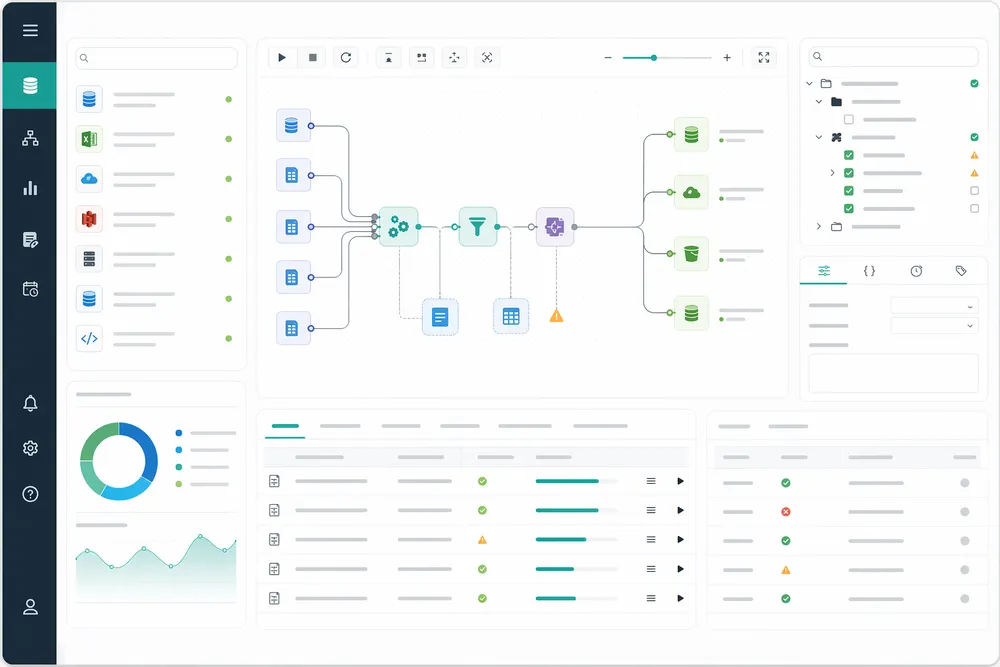
KDRM designs and builds custom ETL, data migration, auditing, and reconciliation tools for organisations that need reliable movement of data between databases, APIs, files, cloud platforms, enterprise systems, and spatial environments. We use FME, Alteryx, Python, SQL, ArcPy, and other custom-developed tools depending on the client environment, the volume of data, the complexity of the transformations, and the level of automation required.
These tools are used for both one-off migration programs and repeatable operational workflows. In some cases the requirement is a large cutover from one platform to another. In other cases the requirement is to support ongoing promotion of content and services between enterprise environments such as DEV, UAT, staging, and PROD with full traceability, validation, and rollback planning.
What the product supports
- Extraction, transformation, validation, reconciliation, and loading of spatial and non-spatial data.
- Schema mapping and transformation logic between legacy and target data models.
- Automated migration of feature classes, tables, services, web maps, documents, and related configuration.
- Data-quality auditing for feature classes, feature services, map services, web maps, and other GIS content.
- Exception reporting, remediation worklists, and migration audit trails to support controlled delivery and handover.
- Scheduled ETL jobs, batch migration runs, and operational support tooling for long-running programs.
ArcMap to ArcGIS Pro migration automation
KDRM has developed Python-driven migration tooling to automate the migration of ArcMap map documents to ArcGIS Pro projects. Our tooling inventories MXD files, converts them to APRX projects, validates the migration results, and produces reporting on migration outcomes, exceptions, data-source issues, broken layers, and items that require manual remediation.
We have used this approach to migrate hundreds of ArcMap map documents for multiple clients. The value of this type of tooling is not just speed. It also provides repeatability, auditability, quality assurance, and a defensible record of what migrated successfully, what failed, and what still requires manual follow-up.
Enterprise environment migration and promotion
We have also built tools for automated migration and promotion of map services, feature services, and related web mapping content between enterprise environments. This includes controlled movement between environments such as DEV, UAT, and PROD, along with the supporting checks needed to confirm that services, dependencies, and configuration remain valid after promotion.
On major client environments, KDRM has used automated migration tools to move hundreds of web maps and feature services across multiple enterprise environments in a very short timeframe. We have also built approaches that reduce or remove unnecessary republishing bottlenecks by connecting approved service layers directly to managed data stores and APIs where that is the better long-term operational design.
Auditing and quality-assurance tooling
In addition to migration tooling, KDRM has developed many tools for auditing feature classes, feature services, map services, web maps, and related GIS content. These tools are used to identify broken layers, invalid data sources, schema inconsistencies, missing metadata, geometry or attribute issues, service configuration problems, and other risks that commonly appear in large enterprise estates.
This auditing capability is especially important in large transformation programs because it allows teams to assess readiness before migration, validate the results after migration, and produce clear issue logs for remediation. Where required, we also support automated unit tests, integration tests, deployment run sheets, software deployment strategies, and operational handover documentation.
Project and sector experience
KDRM has led and supported data migration and transformation work across multiple large-scale projects and sectors, including cadastre, utilities, rail, mining, and environmental programs. That experience includes desktop GIS content, enterprise geodatabases, service layers, web mapping content, APIs, and broader spatial application integration.
Our delivery model is designed for high-accountability migration work: senior technical staff, scripted repeatable workflows, clear audit trails, and automation wherever it meaningfully reduces manual effort, risk, and rework. On larger transformation programs, this means we can help establish the migration strategy, build the tooling, execute trial and production migrations, support testing, and provide the reporting and handover required for operational teams to take ownership confidently.