Cutting Stock Waste Minimisation
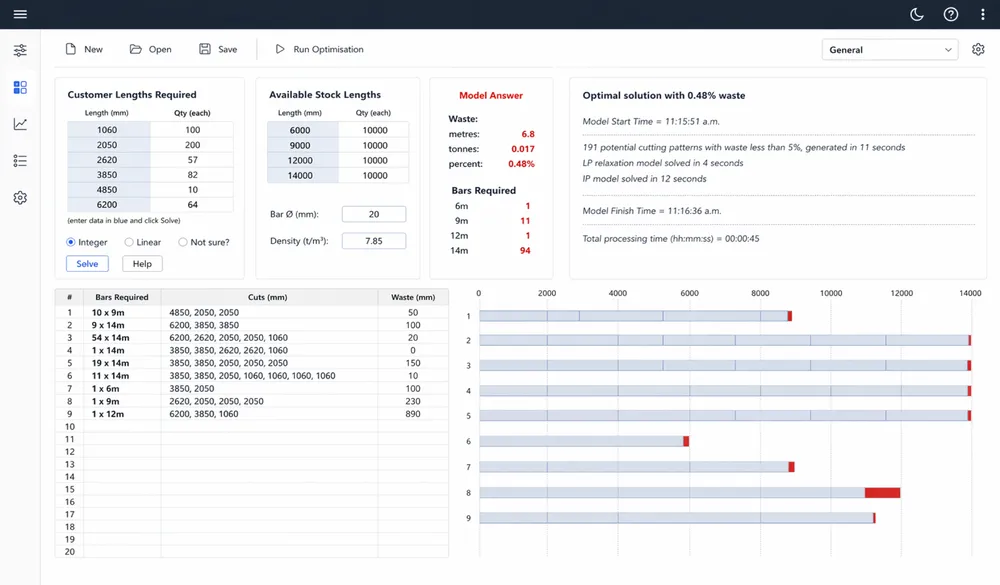
This example shows a cutting stock optimisation model developed to minimise waste when cutting reinforcing bars from straight stock lengths. The model takes the required bar lengths and quantities, compares them against the available stock lengths, and determines the cutting patterns that satisfy demand while minimising offcut waste.
To solve the problem efficiently, we use a very fast pattern-generation algorithm to enumerate all feasible cutting patterns, solve the LP relaxation first to obtain a fast bound and starting point, and then solve the final model as an integer program so the recommended cutting plan is fully implementable in practice.
In the example shown, the model reduced waste from approximately 6-8% under conventional planning to about 0.5%. That represents an approximate 85-94% reduction in waste, which can make a very significant difference on projects where large volumes of reinforcing steel are being purchased and processed.
In cost terms, the value of that improvement scales directly with steel spend. As an indicative example, if a project purchases $1 million of reinforcing bar, waste at 6-8% represents about $60,000-$80,000 of material loss, whereas waste at 0.5% represents about $5,000. That implies a saving of roughly $55,000-$75,000 on steel alone. Additional savings can also come from reduced scrap handling, transport, storage, and operational rework. Actual savings will vary depending on steel prices, procurement volumes, and site conditions.
The model provides a practical way to convert cutting plans into measurable commercial outcomes. Rather than relying on manual trial and error, it generates cutting combinations that improve material utilisation, reduce avoidable waste, and support more consistent planning and reporting across the fabrication workflow.