Route Planner
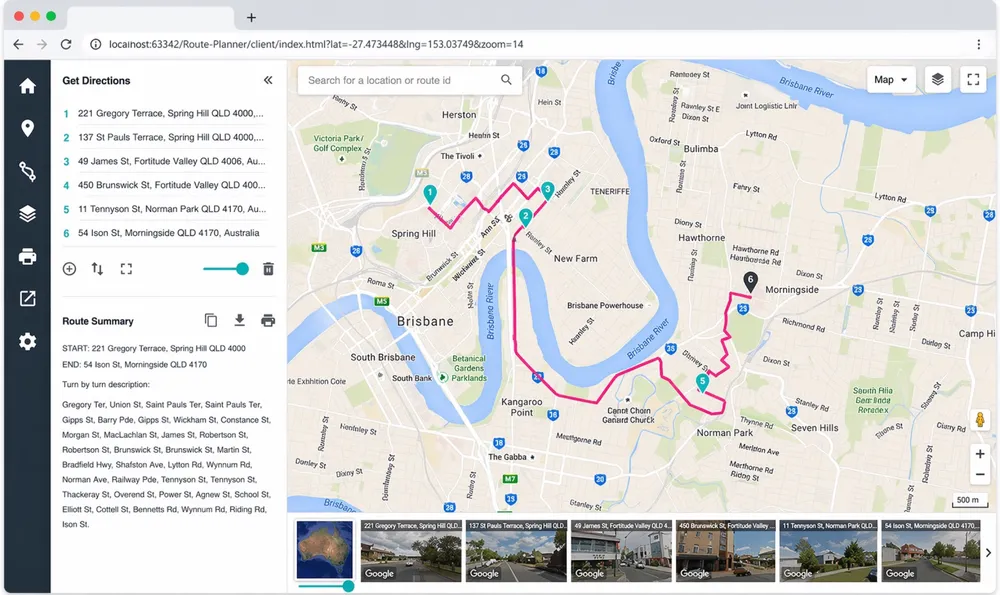
This example shows a route planning application designed for operational teams that need to build, review, and manage multiple delivery routes in a single workflow. Users can create multiple routes for multiple deliveries, add and review those routes on the map, inspect stop-by-stop directions, and export the final routes and instructions to GPS navigation devices for drivers.
The application provides a practical planning interface for day-to-day logistics work. Users can search for stops, add and remove delivery locations, organise and sequence visits, compare alternative routes, and visually review the resulting route geometry on the map before finalising the plan. The combination of the route list, map view, turn-by-turn instructions, and street-level imagery makes it easier to confirm that the selected route is both operationally sensible and easy for drivers to follow.
In addition to route creation, the product can support a much broader set of operational capabilities. For example, it can be extended to account for vehicle restrictions, depot start and end points, delivery time windows, service durations, maximum route length, driver hours, load and capacity constraints, and assignment of stops to specific vehicles or runs. It can also support route balancing across the fleet so workloads remain more even between drivers and vehicles. Depending on customer requirements, the application can also support multiple routing engines, including Google Maps, Mapbox, ArcGIS, OSRM, and other routing services where a client already has an established platform or preferred provider.
The platform can also be configured to support richer operational outputs and controls. These can include printable run sheets, downloadable turn-by-turn directions, export to GPS navigation devices, route summaries, estimated distance and duration reporting, map annotations, custom basemaps, geofences, and route status tracking. Depending on the deployment environment, it can also integrate with external data sources such as customer databases, order systems, telematics platforms, GPS feeds, and scheduling or dispatch systems.
From a product-design perspective, this type of application is valuable because it gives planners a single place to create routes, review them spatially, test scenarios, and generate driver-ready outputs. It reduces manual planning effort, improves consistency across runs, and makes it easier to communicate route changes clearly to drivers and operations staff.