Nurse Roster Scheduling Optimisation
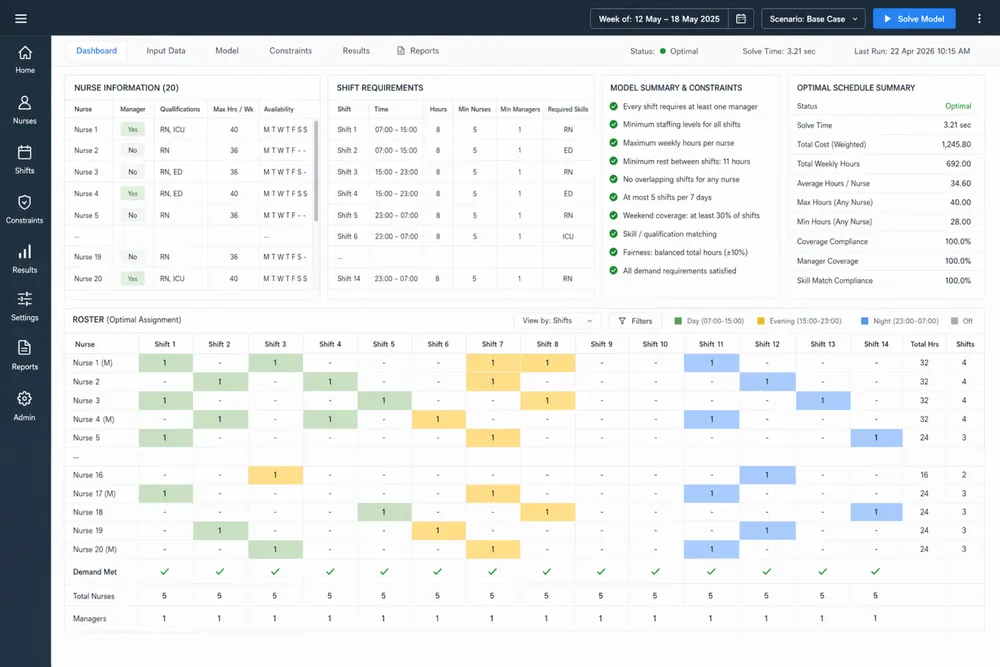
This example shows a nurse roster scheduling optimisation model for assigning nurses to shifts over a planning horizon while satisfying operational, workforce, and governance requirements. In the illustrative example shown, the model schedules 20 nurses across 14 shifts, with each shift carrying its own hours, staffing demand, manager requirement, and qualification requirements.
The underlying model is best represented as a mixed-integer scheduling and assignment model. Each decision variable represents whether a nurse is assigned to a particular shift, and the model then determines the combination of assignments that covers demand while respecting all roster rules. We solve the LP relaxation first to obtain a fast bound and starting point, and then solve the final integer model so the resulting roster is fully implementable in practice.
The example includes a range of realistic constraints for illustration purposes. These include nurse availability, qualification and skill matching, maximum weekly hours, minimum rest between shifts, no overlapping assignments, limits on how many shifts a nurse can work within the planning window, and fairness rules to keep workloads balanced across the team. It also includes leadership constraints, such as requiring at least one manager on every shift, along with shift-specific coverage rules for day, evening, and night shifts.
Additional constraints can easily be incorporated depending on the operating environment. For example, the model can account for weekend rotation rules, preferences and leave requests, limits on consecutive night shifts, minimum ICU or emergency-department coverage, agency or casual staff usage, senior-junior skill mix, and soft penalties for undesirable roster patterns.
The practical value of this type of model is that it can produce high-quality rosters much faster and more consistently than manual scheduling. It gives decision-makers a transparent way to test coverage requirements, staffing policies, and workload trade-offs, while reducing the time spent on roster preparation, revisions, and exception management.