Trade Area Optimisation
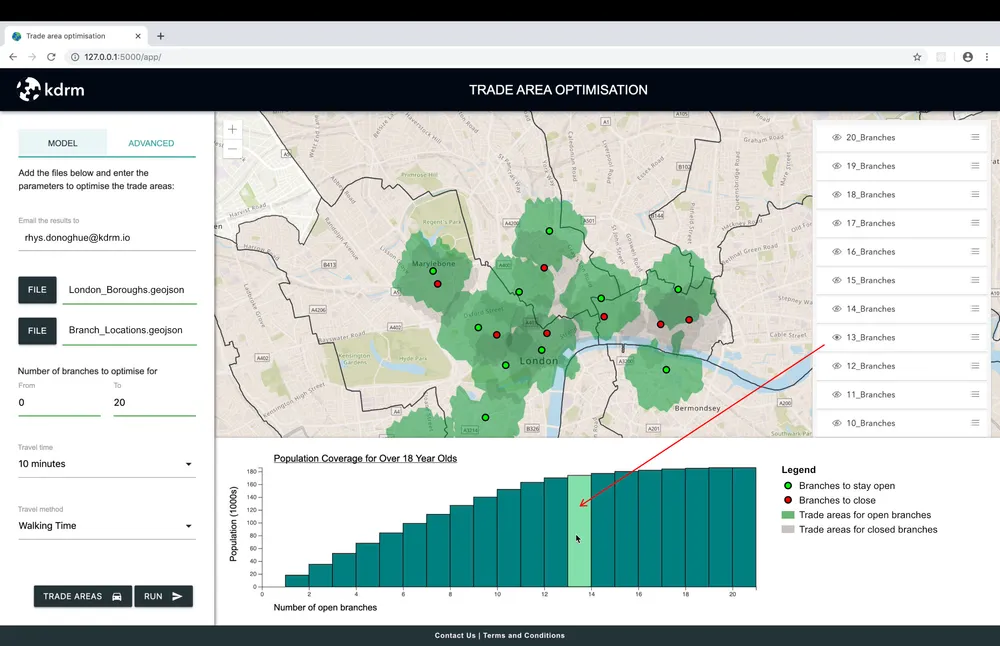
This example shows a simplified trade area optimisation model we created to help evaluate a branch network. The sample data has been changed for this public example, but the optimisation logic and results are representative of the real approach. The model is designed to identify the best combination of branches to keep open by maximising population coverage within each trade area while minimising unnecessary overlap between neighbouring branches.
In practical terms, the model helps answer two related questions. First, if the business wants to keep a fixed number of branches open, such as 15, which 15 locations provide the strongest combined coverage with the least cannibalisation between trade areas? Second, if the business wants to understand the best overall network size, the model can be run across a range of branch counts, such as 0 to 20, and the results compared in a chart. In the example shown, the curve suggests that around 13 branches is the best balance, because keeping more than that adds only limited extra population coverage relative to the additional overlap introduced.
This type of model is useful because trade area decisions are rarely obvious when branches influence each other. If two nearby branches serve largely the same population, closing one may have little impact on overall coverage. On the other hand, a smaller branch may still be strategically important because it fills a geographic gap, supports surrounding locations, or reduces over-reliance on neighbouring sites. The optimisation model evaluates the network as a whole rather than judging each branch in isolation.
This example is deliberately simplified to show the core idea. In a real deployment, the model would normally be extended to include customer visitation patterns, branch performance, revenue or demand potential, travel time, accessibility, parking, public transport, service capacity, strategic catchments, and local operational constraints. In some cases, the right answer may still be to keep two nearby branches open if that area has enough demand or strategic importance. The value of the model is that it provides a transparent and repeatable way to test those scenarios and quantify the trade-offs before decisions are made.