Optimisation, Machine Learning, and Algorithm Design and Development
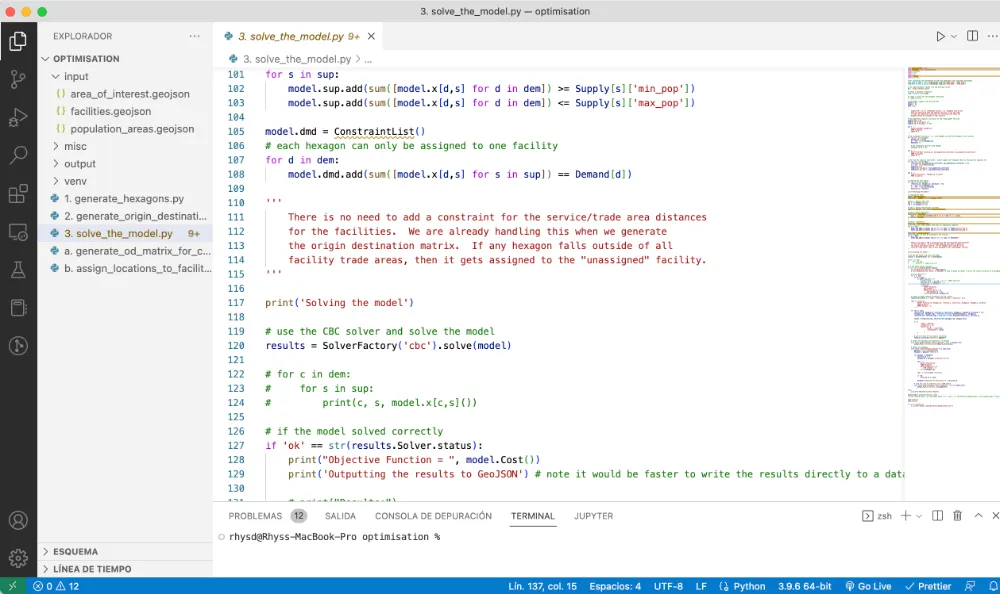
We develop analytical models for problems where there are too many variables, constraints, and trade-offs to manage well by hand. Our work covers spatial and non-spatial optimisation, including location-allocation, site selection, routing, coverage analysis, pressure-zone design, staff rostering, cutting stock, assignment, and scheduling problems.
When a problem requires formal optimisation, we design the model structure, define the objective and constraints, prepare the data pipeline, and implement the solve workflow using tools such as Pyomo, PuLP, COIN-OR, GLPK, and Gurobi. Where machine learning is the better fit, we build models that support forecasting, classification, prioritisation, or pattern detection, typically using Python-based workflows and frameworks such as TensorFlow.
We focus on solutions that are explainable and usable, not just mathematically interesting. That means packaging the outputs in a way that supports real decisions, documenting assumptions, testing against operational scenarios, and, where needed, integrating the model into dashboards, APIs, batch processes, or production products.